

Things Fall Apart
There is no center to "hold" anymore

Let’s talk about the Iran War and its implications.
By that, I don’t mean whether or not this was the greatest deal since the Trump Taj Mahal Casino, Trump University, Trump Ties, or Trump Steaks. Whether this war was ill-advised from the get-go or geopolitical four-dimensional chess that we mere mortals don’t understand as well as Donald Trump. How this compares with Vietnam. Or even whether war is always wrong or America taking on tyrants (which I generally favor) is always right.
Instead, I want to talk not about the war and related current events, so much as its being part of a longer-term trend that I’ve been arguing is coming for quite a while, and what it demonstrates as to the point I’ve been making about the world we’ll all be living in for the next quite-a-while.
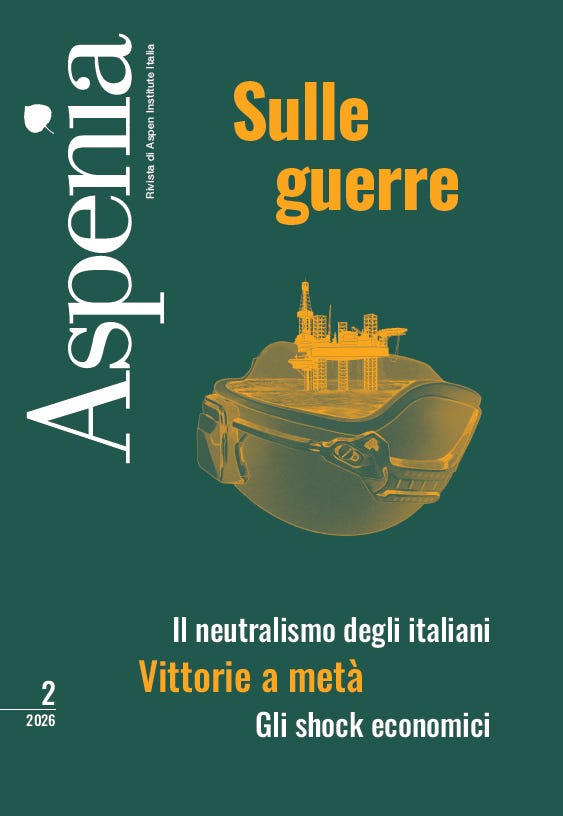
Coincidentally – as this volume, Sulle guerre (“On war”), was planned well before Trump launched his “special military action” in the Middle East – my latest article is now out in the latest issue of Aspenia. Unfortunately, you won’t be able to read it unless you speak Italian (it will be published in English sometime later this summer), so I’d like to summarize it here briefly as the lead-in to our larger discussion.
Its title is, “La Lente del futuro: il mondo patchwork.” Even if you don’t speak Italian, you at least caught the last word: It means, “A lens on the future: the patchwork world.” My own suggested title was, “The Incredible Shrinking World Order,” which better reflects what I’m getting at, but, editors being editors, they ignored that. Here’s the gist of my argument.
President Donald Trump – and, in one way or another, the political and economic commentariat these days – clearly conceives of the return of a Great Powers world with spheres of influence, as opposed to a world in which lots of national actors get to do their own thing. The latter provides for generalized freedom which then occasions or requires some sort of mutually-accepted rules, allowing these individual actors to pursue their own interests without creating total chaos – what one might call, more broadly, “liberalism.” The former says, “Forget rules – or freedom”: As Thucydides (newly in the news) reports that the Athenians told the Melians before exterminating them, “The strong do as they want, and the weak do as they must.” This represents a fundamental distinction in psychological outlook and moral philosophy that underlies everything in the world today, and to which I’ll return in a future post. But, for now, let’s focus just on the “Great Powers, Redux” consensus.
In Trump’s worldview, there are only three powers that matter, and they get to carve the world up between them – and then act dictatorially within their respective spheres – largely as did the corresponding three powers in George Orwell’s 1984 (where Oceania is the U.S.; Eurasia = Russia; and Eastasia = China). Even beyond Trump’s circle, the conventional wisdom today is that we’re headed to (or already living in) some variant of that: Whether Russia is really a great power, except to Trump, and whether the U.S. will long remain one, are the only real points of dispute. But the basic theme of geopolitical discourse today – as well as economic debate, where we similarly appear headed to world domination by three or so Artificial Intelligence companies and their more-or-less dictatorial techbro founders – is that global power is increasingly concentrated in an extremely small number of hands, all of them not-even-thinly-gloved fists.
I want to propose at least the possibility of an alternative: I’ve argued for the last few decades that today’s technologies inherently break things apart and “democratize” virtually everything – rather than, as now commonly perceived, leading inexorably to concentration and authoritarianism. To me, this meant, (a) internationally, Brexit and other secessionist movements around the world and the hollowing out of nation-states as we know them, and, (b) domestically, the fracturing of society into individualized realities politically, economically, and socially. In my view, Trump was always just a reflection of this, not a driver; he has been divisive and, while apparently an authoritarian, more interested in destroying virtually all institutions and pilfering as many of the assets for himself, his family and his friends as possible. That’s not a new Reich – it’s chaos.
None of what’s happening today is surprising if you start with that basic analytic framework. In the last six months, I’ve been working on the chapter on AI for my book project while simultaneously putting together a conference in New York featuring many of the leading minds on the subject. In doing so, I’ve had to consider whether, and to what extent, this new powerful technology of artificial intelligence changes my basic thesis as to the effects on our world of the digital revolution. It’s a lengthy (of course) and subtle discussion, but my basic conclusion (again contrary to what most of the world thinks) is: not much.
In that case, it’s worth considering my basic thesis in the international context, which I do in the new Aspenia piece. Just as Trump’s Second Coming spent Year One laying waste to virtually every domestic institution – constitutional, social, intellectual – the theme for Year Two appears to be to do the same on a global scale. As has become somewhat clearer in the three months since the piece was first conceived and written, Trump’s would-be hegemonic behavior has in fact weakened the U.S. position globally. Just as importantly, in my view, however, the wars right now in both Ukraine and Iran are demonstrating the “surprising” battlefield and geopolitical superiority of smaller powers using smaller, cheaper technologies. All of this was foreseeable years ago. When I first began teaching on the subject 15 years ago at the University of Chicago, it was clear that the emerging 21st Century powers would include places like Estonia, perhaps Ireland, Israel (Bibi Netanyahu, however, has now, like Trump, spectacularly squandered both the technological and political high ground) – small, geographically isolated, but technologically-advanced. You can now add in to that places like Iran and Ukraine.
For instance, in a great piece dissecting the US-Iran “peace agreement,” Claire Berlinski of The Cosmopolitan Globalist writes, almost in passing:
“This war was devastating for the prestige of the US military. It has been shown to be manifestly ill-adapted to the age of cheap, persistent, deniable, and distributed coercion against infrastructure and commerce.”
Berlinksi frames this in terms of “the vanishing authority of American power.” I’d take out the word “American”: Yes, as the pre-eminent global power today (or, at least, yesterday), the US is literally the tip of the spear when it comes to the decay of established power structures. But the key words in what Berlinski wrote are really “cheap” and “distributed,” and the realization that these are destructive of existing large institutions of all kinds, everywhere – whether in the physical world of day-to-day life, or the meta-worlds of political, economic and social power. That today’s technologies are breaking everything apart, and thereby, incidentally, destroying all legacy institutions and power structures, has been my argument for around 30 years.
And the two major “hot wars” today (or, at least, yesterday) – US-Iran and Russia-Ukraine – demonstrate this in the arena of armed conflict and the supposed-”Great Power” world we’ve been moving into at least since Trump’s re-election: Both Iran and Ukraine have fared far better against these larger, stronger, and more technologically-sophisticated Great Powers than they were supposed to do. Iran essentially survived a pounding by half the United States’ world’s-most-advanced arsenal and prevailed politically through the use of cheap, small drones; Ukraine is doing the same against Russia (as I write, the news is coming in of Ukraine’s latest massive drone assault on Russia).
Whether Trump’s deployment of US might was an intelligent move tactically – it was foreseeable (and foreseen) that air power alone would neither topple the regime nor dislodge its buried uranium – it remains open to debate whether massive firepower and technologically advanced weapons might still be successful forms of power projection in better contexts. For instance, the US could clearly nuke Iran out of existence, and Russia could do the same to Ukraine (or China to Taiwan, for that matter); the strategic and political, let alone ethical, effects of doing so are another question. But it’s very clear that the most powerful states, especially if poorly led, are increasingly vulnerable to smaller adversaries with cheaper and dispersed technologies. As a result, it’s not just the technologies – from the Internet to bitcoin to drones – that are low-marginal-cost and dispersed: It is, increasingly, power itself, which means a fracturing, not a consolidating, map. (As my Aspenia piece touches on, this is also true in the political and economic, not just military, realms, as Canadian premier Mark Carney’s celebrated speech at Davos earlier this year made clear.)
The Aspenia piece, then, discusses the possibility that we are moving toward not a stultifying world of a few authoritarian behemoths but rather – as I wrote, as to domestic politics, before both of Trump’s successful elections – a world of collapsing behemoths, vanishingly small units of action, and chaos. The end-point of such fracturing is a multiplicity of powers – each so small it may be just the teenage kid who almost managed to launch a drone attack on Trump’s birthday cage-fight at the White House – to the point of virtuality, i.e. non-territorial and non-state “governments,” as I have long argued (and as techbros like Peter Thiel and J.D. Vance envision).
A good friend, to whom I send most of my pieces before submitting them, pooh-poohed my Aspenia analysis, which, of course, runs counter to current perceptions (at least, until this past week). Then, the Canadian province of Alberta announced that it was planning to secede (my piece references a prior similar movement in Saskatchewan); he still pooh-poohed my analysis. But my point was not that Canada is going to break apart anytime soon. It is, rather, that everything is.
And that’s what Trump’s folly – not just in Iran but, more broadly, in everything – is really a sign of.
In future posts, I want to come back to some of the sub-themes mentioned here: Whether the economy, in the Age of AI, fits this paradigm or not. The splitting apart of politics and political institutions worldwide into two incompatible ideological extremes and the collapse of “institutionalist” centrism – i.e., the 20th Century. The fraying of the nation-state and the dispersal of global power. And, ultimately, then, what this means for the future of our own country – and what we can do about it. But since everyone wants me to keep things shorter these days, I’ll stop here.
The main point for today is that everything, in fact, is falling apart, thanks to today’s technology. The current moment needs to be understood in those terms. It’s not about Trump and his stupidity: Those are just symptoms. Keep your eyes on the underlying causes. I’ll return to that soon.
Thanks for reading.